Accounts Receivable
Account Receivable
Introduction
The Accounts Receivable (A/R) section in UltraCart allows you to review and manage orders that have not completed the payment process. From this area, merchants can:
View detailed order information.
Authorize or reject payments.
Assign custom tags for workflow tracking.
Print invoices, export data, or refresh the display.
This tool provides a centralized workspace for handling orders that require payment follow-up, ensuring efficient processing and minimizing order delays.
Prerequisites
Before using Accounts Receivable, ensure the following are configured:
At least one payment method (e.g., credit card, PayPal, eCheck) is enabled in your UltraCart account.
Your merchant account is linked to an appropriate payment gateway.
Staff members accessing Accounts Receivable have the necessary permissions within UltraCart’s user management.
Viewing Orders
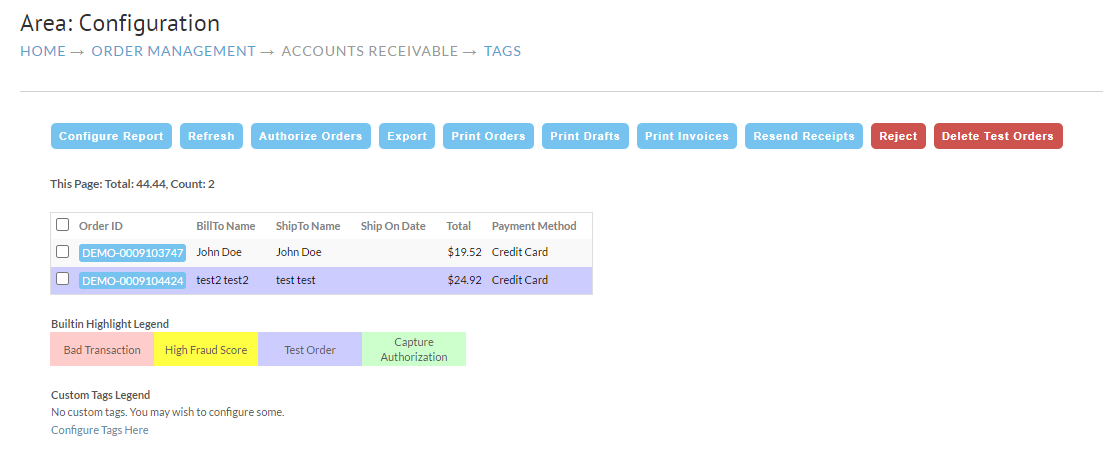
To view a single order, click the hyperlinked Order ID to display full invoice details.
To view multiple orders, use the checkboxes on the left side of the list to select them.
Also notice at the bottom of your page are Four boxes in different colors. Orders are cross-checked as they come into Accounts Receivable and then highlighted accordingly. You can then easily move large numbers of orders instead of having to research each one. For instance, you can quickly select and "reject" all the orders that are highlighted as Test Order to clean up the spreadsheet.
View Order Details
You can view the details and process a single order simply by clicking (once) on the appropriate order id.
Record Grouping
Record Grouping
In the "configure report" page (accessible by clicking the "configure report" button) you are able to configure the report with "order grouping".
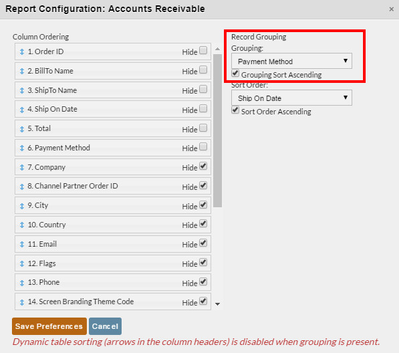
If configured with order grouping, you'll see a red message stating:
" * You have configured a grouping/summary. Table sorting is disabled when grouping is present."
To revert back to the normal ordering by orderID, click the "Configure report" button then choose none in the "record Grouping" drop-down list. Then save changes.

Section Name | Description |
|---|---|
This allows you to configure the display of information within the Accounts Receivable page. | |
Filters | Opens the Filter Accounts Receivable form, where merchants can narrow the Accounts Receivable order list using advanced search criteria such as order ID, payment method, tag, fraud score, dates, customer address information, order totals, transaction details, gateway, and custom field values. |
Refresh | At any given time you can "refresh" the Accounts Receivable screen by clicking on the "Refresh" button. |
Authorize Orders | This attempts to process any orders that have been selected |
Export | This will download an XML file that contains the information for the orders selected. |
Print Orders | This will dynamically generate a PDF document containing one order per page. |
Print Invoices | This will dynamically generate a PDF invoice document containing one order per page that can be mailed to the customer. |
Resend Receipt | This will simply resend a copy of the receipt to the customers email. |
Reject | This will make the order as rejected and remove it from Account Receivable. |
Delete Test Orders | This will delete any and all test order currently in Account Receivable. These orders will be highlighted in blue. |
*Print Draft Checks | UltraCart allows merchants who do not have an e-check gateway to accept e-check orders through the use of draft check printing. |
Filtering Accounts Receivable Orders
The Filter Accounts Receivable form provides advanced filtering for orders currently located in the Accounts Receivable department. Merchants can use this form to narrow the Accounts Receivable order list by order details, dates, customer information, totals, transaction details, and custom field values.
How Filters Work
Filters in the Accounts Receivable screen behave as follows:
Active filters persist across pagination. Moving from page 1 to page 2 (or any subsequent page) will not reset or lose your filter context.
Re-opening the Filters dialog after a page reload shows exactly what you previously applied. Empty fields remain empty — they do not revert to zero or a default placeholder value.
The badge on the Filters button accurately reflects the number of filters you have actively set. Unset fields are not counted.
Stale orders (those already rejected, processed, or otherwise moved out of AR) are automatically removed from view. The system also performs background cleanup to keep future page loads accurate. If you notice a lingering stale order, click Refresh.
To filter Accounts Receivable orders:
Open the Accounts Receivable screen.
Click the 'Filters' button to open the Filter Accounts Receivable form:
Enter one or more filter values.
Click Apply Filter to update the Accounts Receivable order list.
Click Clear to remove the entered filter values.
Click Cancel to close the form without applying changes.
Tip: You do not need to complete every field. Enter only the values needed to narrow the results.
Filter Accounts Receivable Fields
Section | Field Name | Description |
|---|---|---|
General | Order ID | Filters the Accounts Receivable list by a specific UltraCart Order ID. |
General | Channel Partner Order ID | Filters orders by the external order ID assigned by a channel partner or integration. |
General | Payment Method | Filters orders by the payment method associated with the order. |
General | Tag | Filters orders by an assigned Accounts Receivable tag. Tags can be used to track internal review status or workflow ownership. |
General | Auto Order (Rebill) | Filters orders based on whether the order is associated with an auto order or rebill. The default value is Any. |
General | Fraud Score Min | Filters orders with a fraud score greater than or equal to the entered minimum value. |
General | Fraud Score Max | Filters orders with a fraud score less than or equal to the entered maximum value. |
General | Merchant Notes (contains) | Filters orders where the merchant notes contain the entered text. This is useful for finding orders with a specific internal note or processing comment. |
Dates | Creation Date Start | Filters orders created on or after the entered date. |
Dates | Creation Date End | Filters orders created on or before the entered date. |
Dates | Ship-On Start | Filters orders with a ship-on date on or after the entered date. |
Dates | Ship-On End | Filters orders with a ship-on date on or before the entered date. |
Customer Address | First Name | Filters orders by the customer first name. This field matches either the bill-to or ship-to address. |
Customer Address | Last Name | Filters orders by the customer last name. This field matches either the bill-to or ship-to address. |
Customer Address | Company | Filters orders by company name. This field matches either the bill-to or ship-to address. |
Customer Address | Filters orders by customer email address. | |
Customer Address | Phone | Filters orders by customer phone number. |
Customer Address | City | Filters orders by city. This field matches either the bill-to or ship-to address. |
Customer Address | State / Region | Filters orders by state, province, or region. This field matches either the bill-to or ship-to address. |
Customer Address | Postal Code | Filters orders by postal code. This field matches either the bill-to or ship-to address. |
Customer Address | Country | Filters orders by country. This field matches either the bill-to or ship-to address. |
Totals | Total Minimum | Filters orders with an order total greater than or equal to the entered amount. |
Totals | Total Maximum | Filters orders with an order total less than or equal to the entered amount. |
Transaction Details | Gateway | Filters orders by the payment gateway associated with the transaction. |
Transaction Details | Detail Name | Filters orders by a specific transaction detail name. Use this with Detail Value (contains) to locate orders with matching gateway or transaction metadata. |
Transaction Details | Detail Value (contains) | Filters orders where the selected transaction detail contains the entered value. |
Custom Fields | CustomField1 | Filters orders where CustomField1 contains the entered value. |
Custom Fields | CustomField2 | Filters orders where CustomField2 contains the entered value. |
Custom Fields | CustomField3 | Filters orders where CustomField3 contains the entered value. |
Custom Fields | CustomField4 | Filters orders where CustomField4 contains the entered value. |
Custom Fields | CustomField5 | Filters orders where CustomField5 contains the entered value. |
Custom Fields | CustomField6 | Filters orders where CustomField6 contains the entered value. |
Custom Fields | CustomField7 | Filters orders where CustomField7 contains the entered value. |
Custom Fields | CustomField8 | Filters orders where CustomField8 contains the entered value. |
Custom Fields | CustomField9 | Filters orders where CustomField9 contains the entered value. |
Custom Fields | CustomField10 | Filters orders where CustomField10 contains the entered value. |
Filtering by Custom Fields
The Custom Fields section is collapsed by default. To search by a custom field value:
Click the Custom Fields heading to expand the section.
Locate the custom field you want to search.
Enter the value in the matching custom field input.
Click Apply Filter.
[Image Placeholder: Expanded Custom Fields section]
Note: UltraCart provides ten order custom fields, listed as CustomField1 through CustomField10. Enter the search value in the specific custom field that stores the data you want to find.
What is the default sort order for the Accounts Receivable list? | The AR list defaults to oldest orders first. If you need a different sort order, configure it via the Configure Report screen. Note that dynamic table sorting is disabled when a record grouping is present. |
What is the “All” view, and is there a limit to how many orders it displays? | The All view shows your entire AR backlog on a single screen without requiring pagination. It is capped at 5,000 orders to keep the screen responsive. If your backlog exceeds this limit, the system will notify you and direct you to either the paginated view or to use filters to narrow your results. |
Do my filters stay active when I move between pages in the AR list? | Yes. Active filters persist across pagination. Navigating from page 1 to page 2 (or any subsequent page) will not reset or lose your filter context. |
Why does re-opening the Filters dialog show empty fields instead of my previous values? | Empty fields are intentional — they mean no filter has been set for that field. The Filters dialog accurately reflects only what you have actively applied. If you previously set a filter, re-opening the dialog after a reload will show exactly that filter. Fields you left blank remain blank rather than populating with a zero or default value. |
What does the number badge on the Filters button mean? | The badge indicates how many filters you currently have active. It reflects only the filters you have explicitly set — unset or empty fields are not counted. |
Why are old or already-processed orders still appearing in my AR list? | Orders that have been rejected, processed, or otherwise moved out of AR are automatically removed from view and the system performs background cleanup to keep future loads accurate. If you see a lingering stale order, click Refresh. If the problem persists, contact UltraCart Support. |
Visual indicators like High Fraud Score or Capture Authorization are not showing on pages beyond page 1. Is this a known issue? | This was a previously known bug that has been resolved. Visual indicators for High Fraud Score, Bad Transaction, Capture Authorization, and custom tags now display reliably across all pages of the AR list, not just the first page. If you are still experiencing this, try refreshing the page or clearing your browser cache. |
Authorizing Orders
Authorizing orders in the Accounts receivables department will differ depending on the payment type.
Authorizing Credit Card Payments
Batch Authorization for Credit Card orders
Orders with Credit Card as the payment type can be batch authorized, using the "Authorize Orders".
All other payment types are processed one-at-a-time.
Batch Authorization Processing
Select the credit card orders using the checkbox in the left-hand column, then click the "Authorize orders" button to process the payment authorizations for the selected orders.
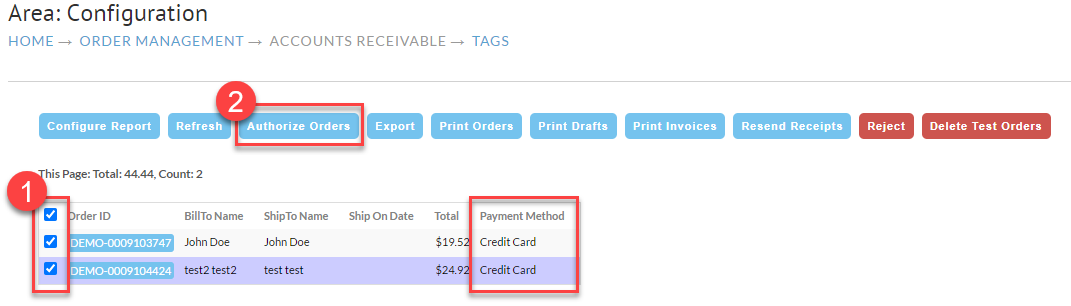
Only Credit Card transactions can be batch authorized. Any other payment method will need to be authorized within the individual order itself.
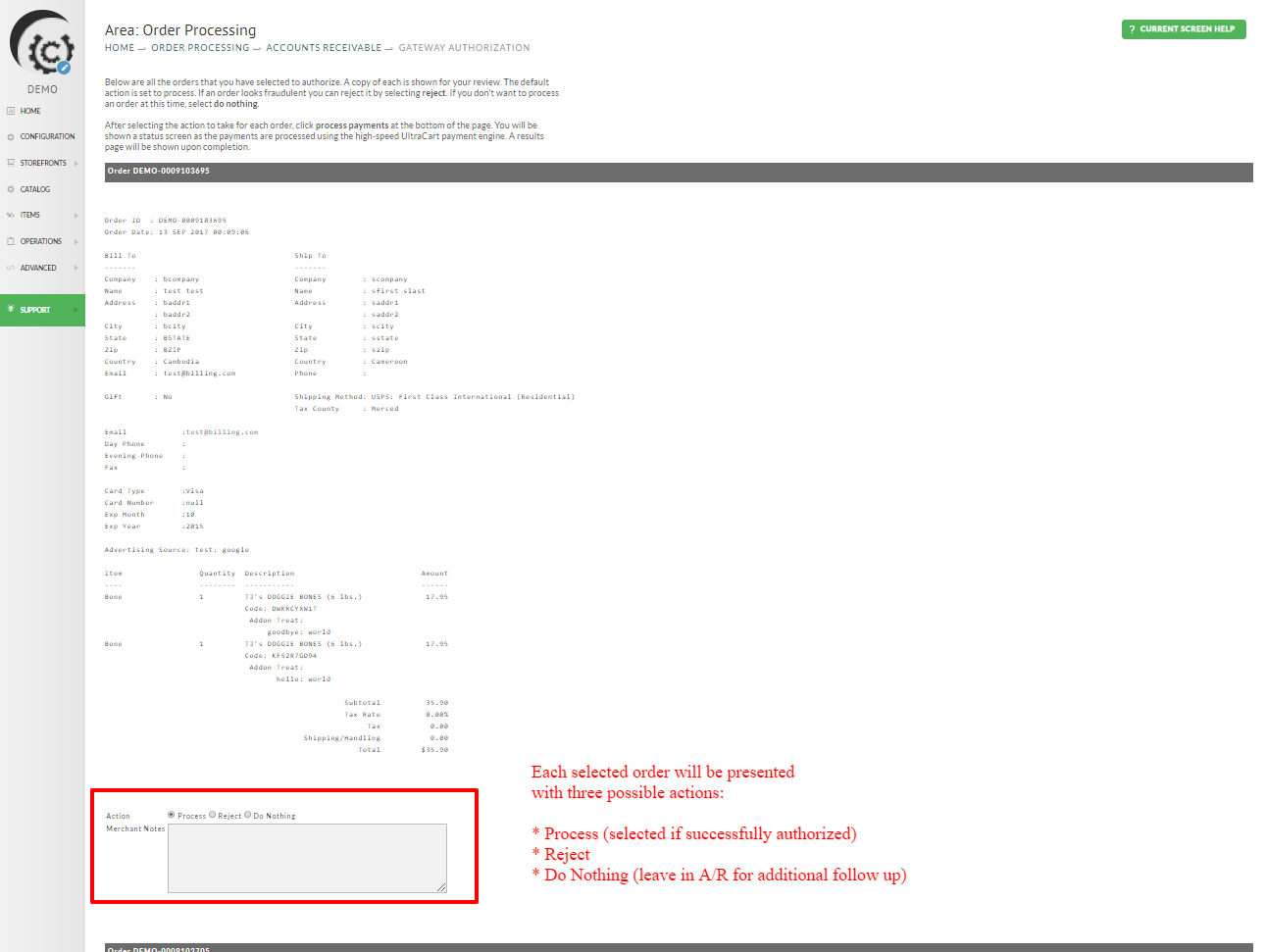
You'll be presented three actions regarding the payment authorization for each of the selected orders, along with a a merchant notes field:
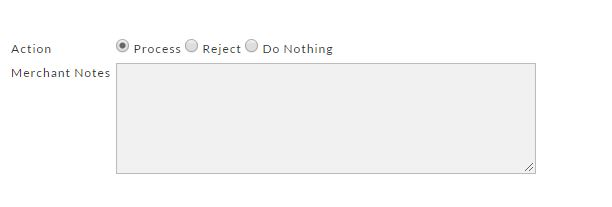
The action will default to "Process" for each order that returns a successful authorization.
You'll have the option to choose to either 'Reject' or 'Do nothing' for the orders that do not return a successful authorization.
Authorizing Individual Orders
Processing
All payments types support individual order processing. Credit card payments will be processed via the integrated credit card processing gateway, while other forms payment must be manually "approved", such as paper check payments, purchase orders, etc.
To authorize individual orders, click on the hyperlinked Order ID, then scroll down below the orders to the "Payment" section, and depending on the payment type click the Process Payment" or "Authorized" button, depending on real-time authorization is enabled or not.
Credit Card Processing
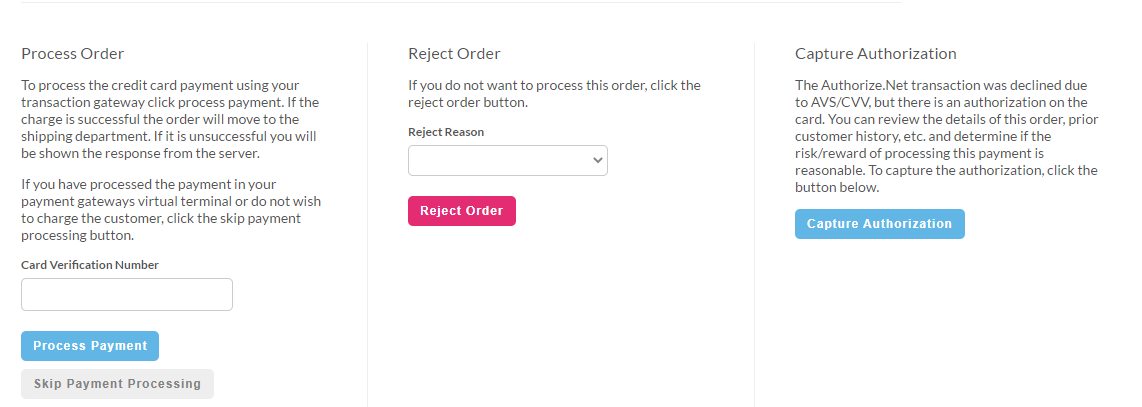
Action buttons when the order was captured to the receipt due to failed attempts at processing the payment during checkout:
View of the action buttons for an order that was processed through Authorize.net and the transaction response resulted in an authorization in which the transaction was declined due to either AVS or CVV rule, but there is an authorization to the card:
When processing the payment of an individual order, you'll be prompted to choose between the following options:
Processing Option | Description |
|---|---|
Process Payment | Click this button to initiate the payment authorization for the order. |
Reject Order | Click to move the order to rejected orders location. |
Skip Payment Processing | ATTENTION: Click this option ONLY if you have determined that no payment is needed for the order and you still want the order to processed to the Shipping Department for order fulfillment. |
Capture Authorization | "The Authorize.Net transaction was declined due to AVS/CVV, but there is an authorization on the card. You can review the details of this order, prior customer history, etc. and determine if the risk/reward of processing this payment is reasonable. To capture the authorization, click the button below." *This option appears only when the gateway is Authorize.net |
Update Billing | “This order had a declined transaction. Click the button below if you desire to send the customer an email to update their credit card information. If the customer clicks the link in the email and fills out their new information, UltraCart will automatically attempt to capture payment. A successful capture will move this order out of Accounts Receivable and into your Shipping Department. A merchant note is added to the order indicating a successful billing update and payment capture.” |
Custom Tags
The new Custom tag system allow you to create your own custom legend for the different stages an order could go thought depending on the process you or your customer service representatives go though. This can be anything from tags for different users so that a user can take ownership of an order while it is waiting to be processed. Or different stages if a customer needs to be called back or emailed.
To configure a custom tag simply click on the text for "Configure Tags Here".
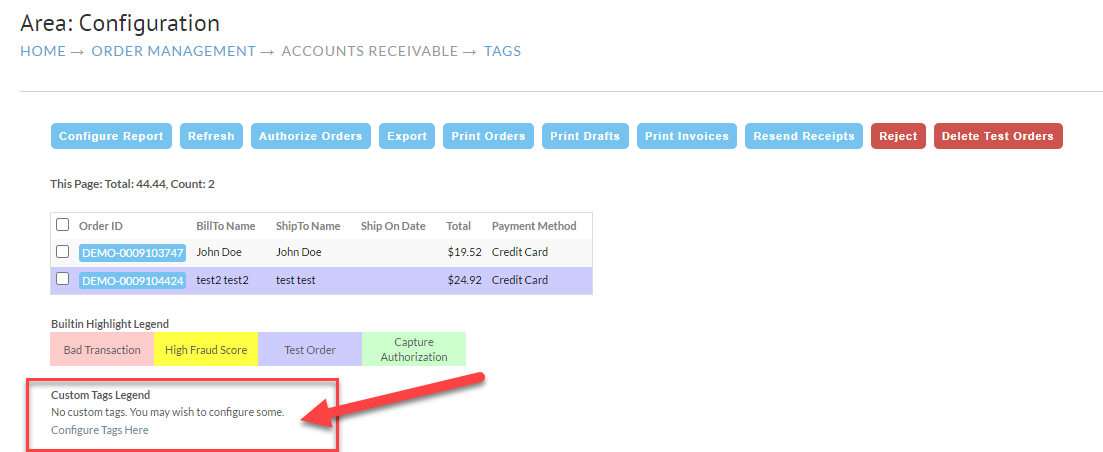
This will open the Configuration screen to create your custom tags.
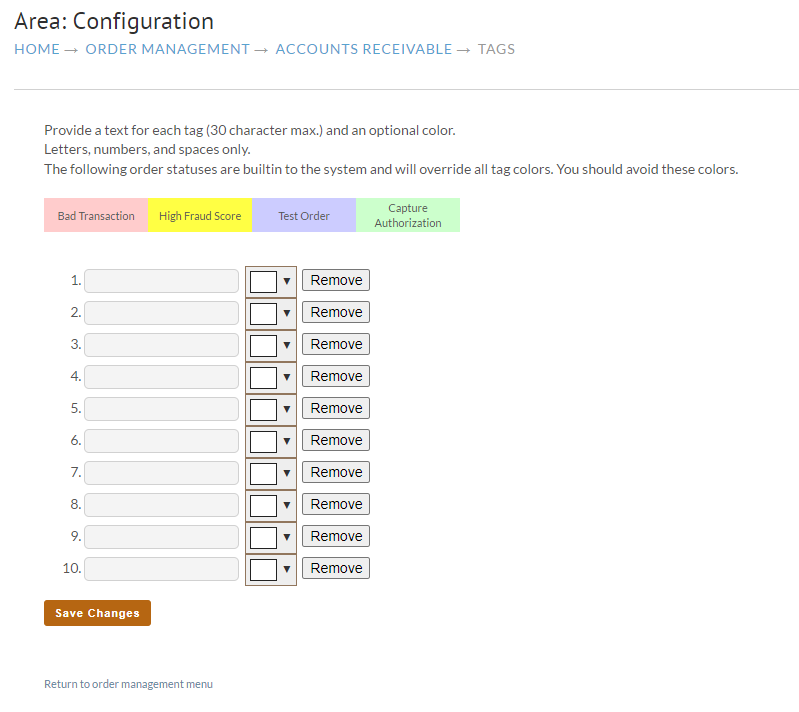
Simply fill in the field with the desired tag name and select the color drop down to assign a color. This can be any of the default colors provided, with the color picker or with a hex color code as shown below.
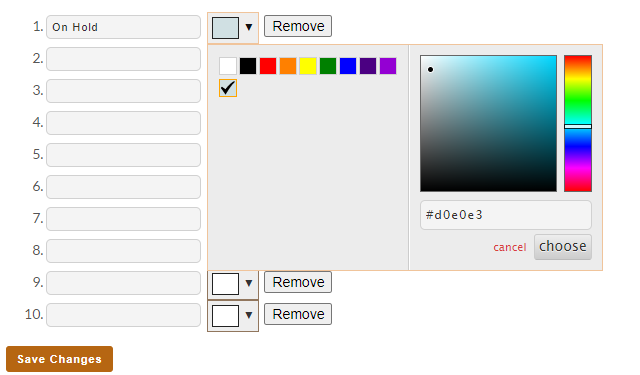
Once you have your different tags and colors configured simply Save Changes to be taken back to Account Receivable.
Now that you have a tag configured it will be displayed at the bottom of the page with the color selected and the tag name.
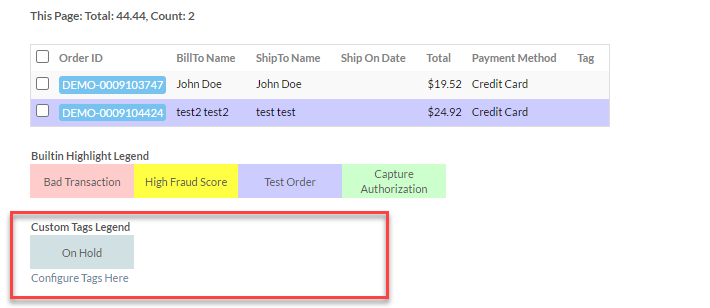
Assigning a Tag to an order
After creating tags, click Configure Report → locate the tag column → click the eyeball icon to unhide it. If you wish to reorder the columns, you can do so by left mouse-clicking and then dragging the columns up or down the list.
You should now have a column within the headline of Tag, to add a tag to an order simply right click on the column for the order. It will be slightly highlighted as shown below.
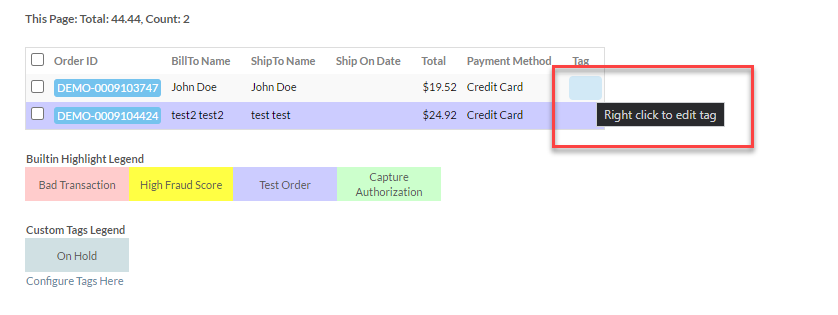
After right clicking on the column for the order in question a select popup will be displayed. This will allow you to assign a new tag to an order, change the tag on an order or remove the tag altogether.
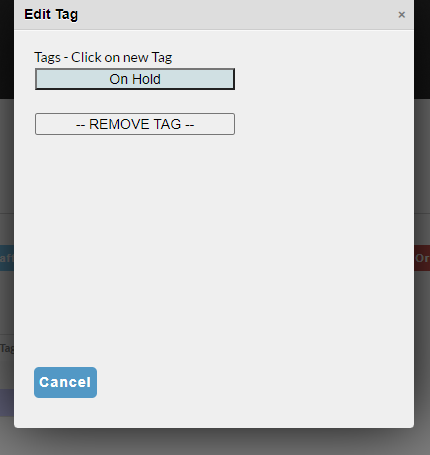
If we click on the tag name we will be taken back to the Accounts Receivable screen where it has been assigned to the order and the display has been updated.
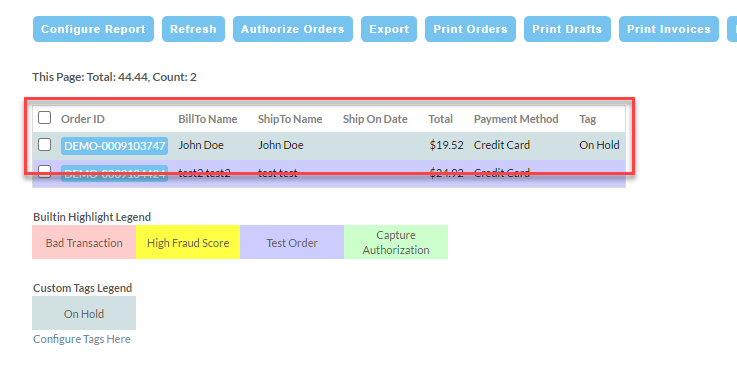
There is currently no limit to the number of tags you can create, however you can only create 10 tags at a time. You will need to save your changes and come back to add more tags.
Frequently Asked Questions
What is Accounts Receivable used for?
Accounts Receivable is used to process orders that have not completed payment, either because authorization failed or manual approval is required.
Why can’t I batch authorize all payment types?
Only credit card orders can be batch-authorized. Other methods (checks, purchase orders, PayPal) must be handled individually.
How do I show my custom tags in the Accounts Receivable screen?
After creating tags, click Configure Report → locate the tag column → click the eyeball icon to unhide it.
Can I reorder the columns in my Accounts Receivable report?
Yes. In the Configure Report screen, drag columns using the three-line handle to reorder them.
What happens when I reject an order?
Rejected orders are removed from the Accounts Receivable queue and no longer appear for payment processing.